The Final 70 Days: Vincent van Gogh in Auvers-sur-Oise
A Journey Through the Artist's Last Masterpieces
December 2024
"I still love art and life very much indeed." — Vincent van Gogh, letter to Theo, July 1890
Arrival in Auvers: A New Beginning
On May 20, 1890, Vincent van Gogh arrived in the small village of Auvers-sur-Oise, located approximately 30 kilometers northwest of Paris. After spending a year at the asylum in Saint-Rémy-de-Provence, the artist sought a fresh start under the care of Dr. Paul Gachet, a physician and amateur painter who had treated several artists. The picturesque village, with its thatched cottages, wheat fields, and winding paths, would become the setting for one of the most prolific and emotionally charged periods in art history.
Vincent rented a modest room at the Auberge Ravoux, a small inn on the town's main square. The room, measuring just seven square meters, would serve as his living quarters and occasional workspace. Despite its cramped dimensions, Vincent found inspiration in the surrounding landscape. The rolling hills, expansive skies, and agricultural rhythms of rural France resonated deeply with his artistic vision and his memories of the Dutch countryside from his youth.
During these 70 days, Vincent would create more than 70 paintings and numerous drawings—an average of more than one painting per day. This extraordinary output reflected both his renewed energy and an underlying urgency that permeated his work. The paintings from this period reveal a complex emotional landscape, oscillating between moments of serene beauty and expressions of profound inner turmoil.
The village itself became Vincent's primary subject. He painted its church, its town hall, its gardens, and its inhabitants with an intensity that suggested both deep appreciation and desperate documentation. Each canvas seemed to capture not just the visual appearance of Auvers, but also Vincent's emotional response to this place that represented his last hope for stability and artistic fulfillment.
The Church at Auvers: Architecture and Anxiety
One of Vincent's most iconic works from this period is "The Church at Auvers," painted in early June 1890. The 13th-century Gothic church dominates the composition, its solid stone structure rendered in deep blues and purples that contrast dramatically with the bright cobalt sky. The building appears to loom over the viewer, its architectural mass both imposing and somehow vulnerable.
What makes this painting particularly striking is its emotional ambiguity. The church, traditionally a symbol of sanctuary and spiritual comfort, appears isolated and somewhat foreboding. The path in the foreground splits, with a small figure—possibly a peasant woman—walking away from the church rather than toward it. This detail has been interpreted as reflecting Vincent's own conflicted relationship with religion and his sense of spiritual displacement.
The painting's technique reveals Vincent's mature style at its peak. The brushstrokes are bold and directional, creating a sense of movement and energy that animates the entire composition. The sky swirls with dynamic force, while the church's stone walls are built up with thick, textured paint that gives them physical presence. The grass in the foreground writhes with life, each blade rendered as a distinct mark of color.
The color palette is particularly significant. Vincent uses complementary colors—the deep blue-purple of the church against the orange-tinted path, the green grass against touches of red in the roof—to create visual tension and vibrancy. Yet despite this chromatic intensity, the overall mood is somber, even melancholic. The church seems to stand as a monument to something lost or unattainable, a symbol of the spiritual certainty that eluded Vincent throughout his life.
Portrait of Dr. Gachet: Melancholy and Understanding
In early June, Vincent completed one of his most psychologically penetrating portraits: "Portrait of Dr. Gachet." The painting shows the physician seated at a table, his head resting on his right hand in a pose that suggests deep contemplation or perhaps sadness. Dr. Gachet's expression is one of profound melancholy, his eyes gazing downward with an air of resignation or empathy.
Vincent described the portrait in a letter to his sister Wilhelmina: "I have painted the portrait of M. Gachet with an expression of melancholy which might well seem like a grimace to those who see it... Sad but gentle, yet clear and intelligent, that is how many portraits ought to be done." This statement reveals Vincent's intention to capture not just physical likeness but emotional truth—the inner life of his subject.
The painting's color scheme is dominated by blues and greens, creating a cool, contemplative atmosphere. Dr. Gachet wears a blue coat, and the background features swirling patterns in various shades of blue that echo the emotional tone of the portrait. On the table before him lie two yellow novels and a sprig of foxglove, a plant used in cardiac medicine but also associated with healing and protection.
Many art historians have noted that this portrait seems to reflect Vincent's own emotional state as much as Dr. Gachet's. The melancholy expression, the sense of isolation despite the intimate setting, and the overall mood of quiet desperation all suggest that Vincent was projecting his own feelings onto his subject. In painting Dr. Gachet's sadness, Vincent may have been attempting to understand and externalize his own psychological struggles.
Vincent created two versions of this portrait, both in June 1890. The first version, with its more intense colors and emotional directness, would later become one of the most valuable paintings in the world, selling at auction in 1990 for $82.5 million. But beyond its monetary value, the portrait remains a powerful testament to Vincent's ability to capture the complexity of human emotion and his own struggle with mental anguish.
Wheatfield with Crows: Turbulence and Finality
Perhaps no painting from Vincent's final period has generated more discussion and interpretation than "Wheatfield with Crows," created in July 1890. Long considered to be Vincent's last painting—though recent scholarship suggests he may have completed other works after it—this canvas has become synonymous with the artist's tragic end and his turbulent emotional state.
The painting depicts a vast wheat field under a dark, stormy sky. Three paths diverge into the field, creating a sense of uncertainty and multiple possibilities. Above the golden wheat, a flock of black crows flies in various directions, their dark forms stark against the turbulent sky. The composition is unusual for Vincent—it's a double-square format, wider than it is tall, which creates a sense of expansiveness and perhaps overwhelming space.
The emotional intensity of "Wheatfield with Crows" is undeniable. The sky roils with dark blues and blacks, suggesting an approaching storm or perhaps a more metaphorical darkness. The wheat, rendered in vibrant yellows and golds, seems to writhe and surge like waves on a turbulent sea. The crows, traditionally symbols of death or ill omen in Western art, add to the painting's ominous atmosphere.
Yet the painting is not simply a expression of despair. The wheat field, despite the threatening sky, glows with life and vitality. The paths, though they lead to uncertain destinations, suggest movement and possibility. Vincent himself wrote about his wheat field paintings in his last letter to Theo: "I did not need to go out of my way very much in order to try to express sadness and extreme loneliness... I almost think that these canvases will tell you what I cannot say in words, the health and restorative forces that I see in the country."
The technical execution of the painting demonstrates Vincent's complete mastery of his artistic language. The brushstrokes are bold and expressive, each one contributing to the overall sense of movement and energy. The color relationships—the complementary contrast of blue and yellow, the touches of green in the wheat, the stark black of the crows—create a visual intensity that matches the emotional power of the composition.
The Wheat Fields Series: Nature as Mirror
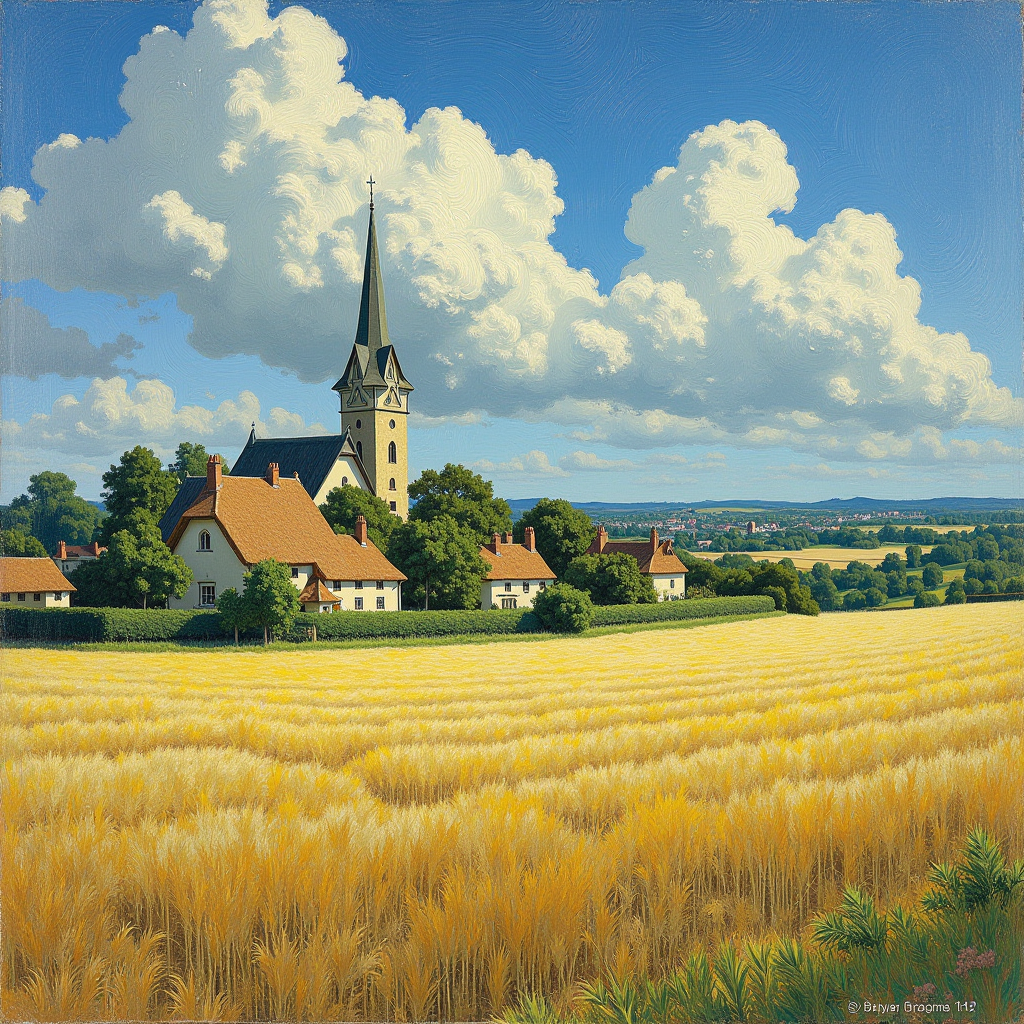
During his time in Auvers, Vincent created numerous paintings of wheat fields in various states and under different atmospheric conditions. These works, taken together, form a kind of visual diary of his emotional journey during these final weeks. Each painting captures a different mood, from serene and contemplative to turbulent and anxious.
In "Wheatfield Under Clouded Sky," painted in July, Vincent depicts a vast expanse of ripening wheat beneath a sky filled with heavy clouds. The composition is simpler than "Wheatfield with Crows," with no paths or crows to complicate the scene. Instead, the focus is entirely on the relationship between earth and sky, between the golden wheat and the blue-gray clouds. The painting conveys a sense of quiet tension, as if nature itself is holding its breath before a storm.
"Wheat Fields at Auvers Under Clouded Sky" presents a similar subject but with a different emotional tone. Here, the wheat field is divided by a path that leads toward distant houses and trees. The sky is lighter, with breaks in the clouds suggesting the possibility of clearing weather. The overall mood is less oppressive, more hopeful, though still tinged with melancholy.
These wheat field paintings reveal Vincent's deep connection to the agricultural landscape and the cycles of nature. The wheat, in various stages of growth and harvest, becomes a metaphor for life itself—for growth, maturity, and eventual decline. Vincent, who had always identified with peasants and agricultural workers, found in these fields a reflection of his own life's journey and perhaps a kind of solace in the eternal rhythms of nature.
The technical approach in these paintings shows Vincent working with increasing freedom and confidence. The brushstrokes become more expressive, more gestural, as if he is trying to capture not just the appearance of the wheat but its essential energy and movement. The paint is applied thickly, creating a textured surface that gives the wheat fields a tactile, almost sculptural quality.
Gardens and Domestic Scenes: Seeking Tranquility
Not all of Vincent's Auvers paintings express turbulence and anxiety. Many works from this period depict gardens, houses, and domestic scenes with a gentler, more contemplative mood. These paintings suggest that Vincent was actively seeking moments of peace and beauty, even as he struggled with his inner demons.
"Daubigny's Garden," painted in July, shows the garden of Charles-François Daubigny, a landscape painter whom Vincent admired. The painting depicts a lush, well-tended garden with flowering plants, trees, and a house in the background. The colors are vibrant but harmonious—greens, blues, and touches of red and yellow creating a sense of natural abundance and careful cultivation.
The painting has a peaceful, almost idyllic quality that contrasts sharply with the turbulent wheat field paintings. Here, nature is ordered and domesticated, suggesting human care and attention. The garden becomes a symbol of the possibility of harmony between human beings and the natural world, a theme that had always been important to Vincent.
Vincent created three versions of "Daubigny's Garden," each with slight variations in composition and color. This repetition suggests that the subject held special significance for him, perhaps representing an ideal of artistic life and domestic stability that he longed for but never fully achieved. The garden, with its careful cultivation and seasonal rhythms, offered a vision of life that was both creative and grounded in everyday reality.
Other garden paintings from this period include "The Garden of Doctor Gachet at Auvers-sur-Oise" and several views of houses with gardens. In these works, Vincent explores the relationship between architecture and nature, between human habitation and the surrounding landscape. The houses are modest, often partially obscured by vegetation, suggesting a harmonious integration of human life with the natural environment.
Emotional Landscape: Reading Vincent's State of Mind
The paintings from Vincent's final 70 days provide a complex and sometimes contradictory picture of his emotional state. On one hand, the sheer productivity of this period—more than 70 paintings in just over two months—suggests energy, purpose, and creative drive. The technical mastery evident in these works shows an artist at the height of his powers, fully in command of his artistic language.
Yet many of these paintings also reveal deep anxiety and emotional turmoil. The turbulent skies, the isolated buildings, the paths that lead nowhere—these elements suggest a mind grappling with uncertainty and perhaps despair. Vincent's letters from this period confirm this interpretation. While he wrote enthusiastically about his work and the beauty of Auvers, he also expressed concerns about his mental health and his ability to continue working.
In a letter to Theo dated July 10, Vincent wrote: "I feel—a failure. That's it as far as I'm concerned—I feel that this is the destiny that I accept, that will never change." This statement reveals the depth of Vincent's despair and his sense of having failed in his life's ambitions. Yet even as he expressed these dark thoughts, he continued to paint with undiminished intensity.
The paintings themselves become a form of emotional documentation, a visual record of Vincent's psychological state during these final weeks. The oscillation between peaceful garden scenes and turbulent landscapes mirrors the fluctuations in his mood. The intense colors and expressive brushwork suggest both vitality and agitation. The recurring motifs—wheat fields, paths, skies—become symbols through which Vincent explored his inner life.
Some art historians have argued that Vincent's final paintings show signs of increasing mental disturbance, pointing to the more chaotic compositions and darker color schemes of works like "Wheatfield with Crows." Others see in these same paintings evidence of artistic breakthrough, of an artist pushing beyond conventional representation to express emotional and psychological truths that could not be captured through more traditional means.
Legacy of the Final Works
On July 27, 1890, Vincent van Gogh suffered a gunshot wound in a wheat field near Auvers. He died two days later, on July 29, with his brother Theo at his bedside. The circumstances of his death remain somewhat mysterious, with recent scholarship questioning the long-held assumption that he died by suicide. Regardless of the exact circumstances, Vincent's death at age 37 brought to an end one of the most remarkable artistic careers in history.
The paintings from Vincent's final 70 days have become some of his most celebrated and valuable works. They represent the culmination of his artistic development, showing a complete mastery of color, composition, and expressive technique. More importantly, they offer an intimate glimpse into the mind and heart of an artist struggling with profound emotional and psychological challenges while continuing to create work of extraordinary beauty and power.
These works have influenced countless artists in the generations since Vincent's death. The expressive use of color, the bold brushwork, the willingness to distort form in service of emotional truth—all of these elements would become central to modern art movements from Expressionism to Abstract Expressionism. Artists as diverse as Edvard Munch, Ernst Ludwig Kirchner, and Willem de Kooning acknowledged their debt to Vincent's example.
Today, the paintings from Auvers-sur-Oise are scattered across museums and private collections around the world. "Portrait of Dr. Gachet" resides in a private collection after its record-breaking sale in 1990. "Wheatfield with Crows" is housed at the Van Gogh Museum in Amsterdam, where it continues to captivate visitors with its emotional intensity. "The Church at Auvers" is part of the collection at the Musée d'Orsay in Paris, while "Daubigny's Garden" can be found at multiple institutions, including the Van Gogh Museum and the Hiroshima Museum of Art.
The village of Auvers-sur-Oise itself has become a pilgrimage site for art lovers from around the world. The Auberge Ravoux, where Vincent lived and died, is now a museum. The wheat fields he painted still exist, and visitors can walk the same paths that Vincent walked, seeing the same landscapes that inspired his final masterpieces. The church, the town hall, and many of the houses he painted remain largely unchanged, offering a tangible connection to the artist and his work.
The paintings from Vincent van Gogh's final 70 days in Auvers-sur-Oise stand as a testament to the power of art to transform suffering into beauty, to give form to the ineffable complexities of human emotion. In these works, we see an artist working at the absolute peak of his creative powers, even as he struggled with profound personal challenges.
These paintings remind us that great art often emerges from the depths of human experience, that creativity and suffering can coexist, and that the act of making art can be both a burden and a salvation. Vincent's final works continue to speak to us across the decades, offering not just aesthetic pleasure but also profound insights into the human condition and the redemptive power of artistic expression.
The paintings discussed in this article can be viewed at the Van Gogh Museum in Amsterdam, which houses the world's largest collection of Vincent van Gogh's works, including many from his final period in Auvers-sur-Oise.