The Influence of Japanese Ukiyo-e Prints on Vincent van Gogh's Artistic Vision
An exploration of Eastern aesthetics in Western painting
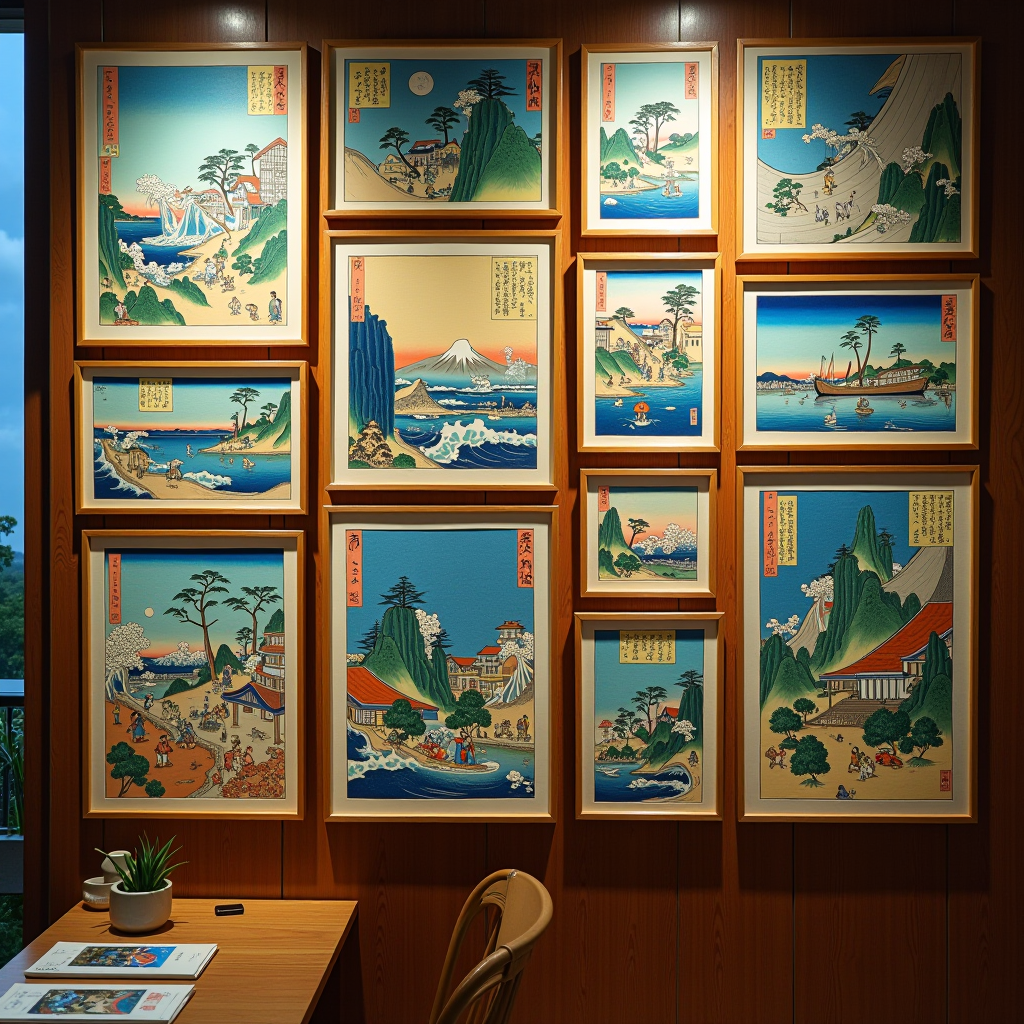
Van Gogh's collection of Japanese prints served as constant inspiration in his studio
"I envy the Japanese the extreme clearness which everything in their work has. It is never boring, and never seems to be done too hastily. Their work is as simple as breathing, and they do a figure in a few sure strokes with the same ease as if it were as simple as buttoning your coat."
— Vincent van Gogh, Letter to Theo van Gogh, 1888
The Discovery of Japonisme
Vincent van Gogh's encounter with Japanese art in the 1880s marked a transformative period in his artistic development. Like many European artists of his generation, Van Gogh was captivated by the wave of Japonisme that swept through Paris following Japan's opening to Western trade in 1854. The ukiyo-e prints, with their bold compositions, flat color planes, and unconventional perspectives, offered a radical departure from the academic traditions that dominated European art.
Van Gogh first encountered Japanese prints in Antwerp in 1885, where he began collecting them from local shops. These prints, often used as packing material for imported goods, were affordable and accessible. He was immediately drawn to their aesthetic qualities: the simplified forms, the emphasis on line and contour, the vibrant yet harmonious color schemes, and the innovative use of space. The prints represented everything he admired in art—directness, emotional honesty, and a connection to nature.
By the time Van Gogh moved to Paris in 1886, his fascination with Japanese art had deepened considerably. He amassed a substantial collection of over 400 prints, studying them intensively and even organizing exhibitions of Japanese art at the Café du Tambourin. These prints became more than mere decorative objects; they were teaching tools, sources of inspiration, and windows into a different way of seeing and representing the world.
The artists whose work most profoundly influenced Van Gogh included Utagawa Hiroshige, Katsushika Hokusai, and Keisai Eisen. Hiroshige's landscape prints, with their atmospheric effects and seasonal themes, particularly resonated with Van Gogh's own interest in capturing the changing moods of nature. Hokusai's dynamic compositions and his famous series "Thirty-Six Views of Mount Fuji" demonstrated how a single subject could be explored through infinite variations of light, weather, and perspective.
Direct Copies and Interpretations
In 1887, Van Gogh created three remarkable oil paintings that were direct interpretations of Japanese prints. These works—"Flowering Plum Orchard (after Hiroshige)," "Bridge in the Rain (after Hiroshige)," and "The Courtesan (after Eisen)"—were not mere copies but rather creative translations that demonstrated his deep understanding of Japanese aesthetic principles while maintaining his own distinctive artistic voice.
"Bridge in the Rain" exemplifies Van Gogh's approach to these interpretations. Working from Hiroshige's print "Sudden Shower over Shin-Ōhashi Bridge and Atake," Van Gogh enlarged the composition and intensified the colors, transforming the delicate woodblock print into a bold oil painting. He maintained the dramatic diagonal rain lines that slice across the composition, the simplified silhouettes of figures crossing the bridge, and the flattened perspective that creates a sense of immediacy and intimacy with the scene.
However, Van Gogh's version is distinctly his own. He added decorative borders featuring Japanese characters copied from other prints, creating a frame-within-a-frame effect that emphasizes the work's status as a homage to Japanese art. His brushwork, while attempting to capture the flatness of the print medium, retains the textural quality and expressive energy characteristic of his painting style. The colors are more saturated and vibrant than in the original print, reflecting Van Gogh's personal palette and his desire to capture what he perceived as the essential spirit of Japanese art.
"Flowering Plum Orchard" demonstrates similar principles of interpretation. Based on Hiroshige's print from the series "One Hundred Famous Views of Edo," Van Gogh's painting captures the essence of the Japanese composition—the bold diagonal branch cutting across the picture plane, the delicate blossoms rendered with careful attention, and the flattened background suggesting distant landscape. Yet he transforms the work through his characteristic use of impasto and his more expressive handling of paint, creating a synthesis of Eastern composition and Western painting technique.
Compositional Innovations and Spatial Arrangements
The influence of Japanese prints on Van Gogh's compositional approach extended far beyond his direct copies. Throughout his mature work, particularly during his time in Arles and Saint-Rémy, Japanese aesthetic principles became deeply integrated into his visual language. The most significant of these influences was the Japanese approach to pictorial space, which rejected the traditional Western emphasis on linear perspective and atmospheric depth in favor of flattened planes and decorative surface patterns.
In works like "The Bedroom" (1888), Van Gogh employed a high viewpoint and tilted perspective that recalls Japanese spatial arrangements. The room is presented with minimal depth cues, and objects are arranged in a manner that emphasizes their decorative qualities rather than their three-dimensional reality. The bold outlines around forms, the flat areas of color, and the overall emphasis on pattern over volume all reflect Japanese influence. This approach creates a sense of intimacy and immediacy, drawing the viewer into the space while simultaneously emphasizing the painting's existence as a two-dimensional surface.
Van Gogh's use of cropping and framing also shows clear Japanese influence. In ukiyo-e prints, subjects are often dramatically cropped at the edges of the composition, creating dynamic tensions and suggesting a world that extends beyond the picture frame. Van Gogh adopted this technique in works like "Almond Blossom" (1890), where branches extend beyond the canvas edges, and in his portraits, where figures are sometimes cut off in unexpected ways. This approach creates a sense of spontaneity and captures a moment in time rather than presenting a carefully staged composition.
The diagonal composition, a hallmark of Japanese prints, became a recurring element in Van Gogh's work. Whether in the rain lines of "Bridge in the Rain," the receding rows of trees in his orchard paintings, or the swirling patterns in "The Starry Night," Van Gogh used diagonal movements to create visual energy and guide the viewer's eye through the composition. This dynamic approach to pictorial structure contrasts with the more static, horizontally and vertically oriented compositions typical of traditional European landscape painting.
Color Theory and Decorative Flatness
Japanese prints profoundly influenced Van Gogh's approach to color, encouraging him to use pure, unmixed hues and to embrace the decorative potential of flat color areas. In ukiyo-e prints, colors are applied in distinct, unmodulated zones, creating bold contrasts and harmonious relationships without the gradual tonal transitions typical of Western oil painting. Van Gogh recognized that this approach could intensify emotional expression and create more powerful visual impact.
In his Arles period, Van Gogh increasingly employed flat areas of color bounded by strong contours, a technique directly inspired by Japanese woodblock prints. Works like "The Yellow House" (1888) demonstrate this approach, with its bold blocks of yellow, blue, and green creating a vibrant, almost poster-like effect. The painting eschews subtle tonal modeling in favor of clear, distinct color zones that emphasize the decorative and expressive potential of pure hue.
Van Gogh's famous series of sunflower paintings also reflects Japanese influence in their treatment of color and form. The flowers are rendered with bold, simplified shapes and intense yellows that recall the flat, decorative quality of Japanese prints. The backgrounds are often single-toned or minimally varied, focusing attention on the subject and creating a sense of timeless, iconic presence similar to that found in Japanese nature studies.
The use of complementary colors, which Van Gogh studied intensively, was reinforced by his observation of Japanese prints. He noted how Japanese artists juxtaposed colors for maximum vibrancy and emotional effect, using combinations like blue and orange, red and green, or yellow and purple. This approach aligned with contemporary color theory but was given practical demonstration in the prints he studied. Van Gogh's landscapes, portraits, and still lifes increasingly employed these complementary relationships to create visual tension and expressive power.
The Philosophy of Simplicity and Directness
Beyond technical and compositional influences, Japanese art offered Van Gogh a philosophical approach to art-making that resonated deeply with his own values. He admired what he perceived as the simplicity, directness, and honesty of Japanese artists—qualities he believed were lacking in much contemporary European art. In his letters, Van Gogh frequently praised the Japanese for their ability to capture the essence of a subject with minimal means, creating works that were both economical and profound.
This philosophy of simplicity influenced Van Gogh's working method. He sought to paint quickly and directly, capturing his immediate response to a subject rather than laboring over academic refinements. His characteristic bold brushstrokes and simplified forms reflect this desire for directness and authenticity. Like the Japanese artists he admired, Van Gogh wanted his work to appear effortless and spontaneous, even when it was the result of careful observation and intense concentration.
Van Gogh also embraced the Japanese emphasis on nature observation and the celebration of simple, everyday subjects. Japanese prints depicted ordinary scenes—people crossing bridges, workers in fields, flowers in bloom—with the same care and attention given to grand historical or mythological subjects in Western academic art. This democratic approach to subject matter aligned perfectly with Van Gogh's own interests and his belief that art should be accessible and meaningful to ordinary people.
The concept of the artist as a careful observer of nature, working in harmony with natural rhythms and seasonal changes, particularly appealed to Van Gogh. He saw in Japanese art a model for a life dedicated to art-making that was both spiritually fulfilling and practically sustainable. His move to Arles in 1888 was partly motivated by his desire to create a "Studio of the South" where artists could live and work in a manner he imagined was similar to Japanese artists—simply, communally, and in close connection with nature.
Legacy and Integration
The influence of Japanese prints on Van Gogh's work represents one of the most successful examples of cross-cultural artistic exchange in the history of Western art. Rather than simply appropriating Japanese motifs or techniques, Van Gogh engaged deeply with the underlying principles of Japanese aesthetics, integrating them into his own distinctive visual language. The result was not imitation but transformation—a genuine synthesis that enriched both traditions.
By the time of his death in 1890, Van Gogh had fully absorbed Japanese influences into his work. The bold compositions, flat color areas, decorative patterns, and simplified forms that characterized his mature style were no longer conscious borrowings but integral elements of his artistic vision. Works like "Wheatfield with Crows" (1890) demonstrate how completely he had synthesized Eastern and Western approaches, creating paintings that are simultaneously deeply rooted in the European landscape tradition and informed by Japanese spatial and compositional principles.
Van Gogh's engagement with Japanese art also had broader implications for the development of modern art. His example demonstrated how artists could look beyond their own cultural traditions for inspiration and renewal, opening pathways that would be further explored by subsequent generations of modernists. The flattening of pictorial space, the emphasis on decorative surface, the use of bold color and simplified form—all principles Van Gogh learned from Japanese prints—became central to the development of twentieth-century art movements from Fauvism to Abstract Expressionism.
Today, Van Gogh's collection of Japanese prints, preserved in the Van Gogh Museum in Amsterdam, stands as a testament to his deep engagement with Eastern art. These prints, carefully studied and treasured by the artist, offer insight into the sources of his inspiration and the breadth of his artistic interests. They remind us that great art often emerges from dialogue between cultures, from the willingness to learn from different traditions, and from the courage to synthesize diverse influences into something entirely new and personal.
Conclusion
The influence of Japanese ukiyo-e prints on Vincent van Gogh's artistic development represents a profound example of cultural exchange and artistic transformation. Through his careful study of Japanese aesthetics, Van Gogh discovered new approaches to composition, color, and pictorial space that helped him develop his distinctive mature style. More than mere technical borrowings, these influences reflected a deeper philosophical alignment with Japanese values of simplicity, directness, and reverence for nature. Van Gogh's synthesis of Eastern and Western artistic traditions not only enriched his own work but also contributed significantly to the broader development of modern art, demonstrating the creative potential that emerges when artists engage openly and thoughtfully with diverse cultural traditions.