Vincent van Gogh's Transformative Period in Arles: February 1888 to May 1889
A comprehensive exploration of the artist's most prolific and revolutionary fifteen months in the South of France
The Journey South: Seeking Light and Color
On February 20, 1888, Vincent van Gogh arrived in Arles, a small town in the Provence region of southern France, seeking escape from the gray Parisian winter and the artistic circles that had left him feeling isolated. At thirty-four years old, the Dutch painter was embarking on what would become the most productive and artistically revolutionary period of his career. The journey from Paris took nearly fifteen hours by train, and as Vincent stepped onto the platform in Arles, he was greeted by a landscape blanketed in snow—an ironic welcome to the sunny south he had imagined.
The decision to move to Arles was not impulsive. Van Gogh had been captivated by Japanese prints and their vibrant depictions of nature, and he believed that the light of southern France would offer him similar chromatic possibilities. In letters to his brother Theo, Vincent described his vision of establishing an artists' colony in the south, a "Studio of the South" where like-minded painters could work together, share ideas, and create art free from the commercial pressures of Paris. This dream would shape his entire Arles period, influencing both his artistic output and his personal relationships.
Initially, Van Gogh rented a room at the Hôtel-Restaurant Carrel, where he would spend the first months observing and sketching the town and its surroundings. Despite the unexpected cold weather, he immediately began working, driven by an almost manic energy that would characterize his entire stay in Arles. Within days of his arrival, he had completed several drawings and was planning his first major canvases. The artist's letters from this period reveal his excitement and determination: he wrote of working from dawn until dusk, barely stopping to eat, consumed by the need to capture the unique quality of Provençal light.
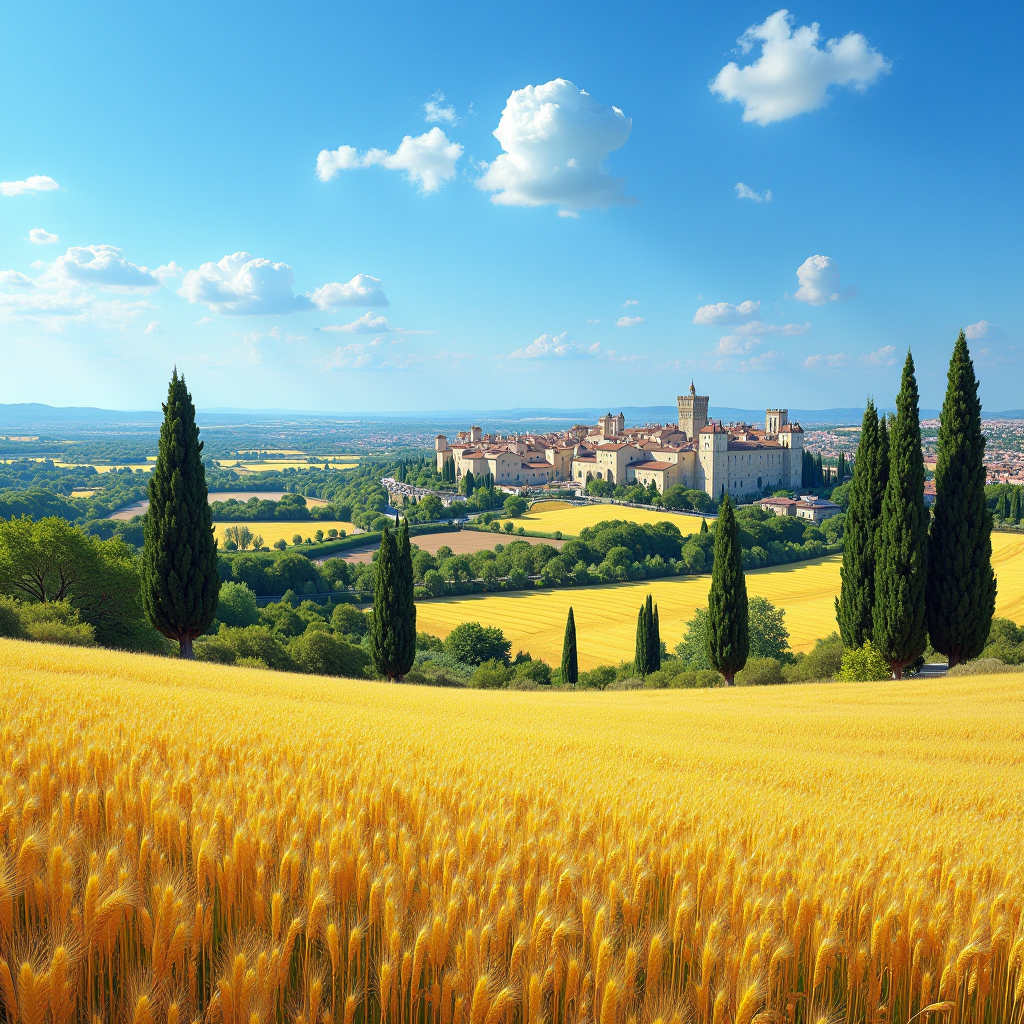
The landscape around Arles provided Van Gogh with an entirely new visual vocabulary. The flat plains, the distinctive cypress trees, the ancient Roman ruins, and the vibrant agricultural fields offered subjects that were radically different from the urban scenes and Dutch countryside he had previously painted. More importantly, the quality of light in Provence—clear, intense, and transformative—allowed him to explore color relationships with unprecedented boldness. This southern light would become the catalyst for his mature style, pushing him toward the brilliant yellows, deep blues, and vibrant greens that would define his most celebrated works.
The Yellow House and the Dream of Community
In May 1888, Van Gogh rented four rooms in a building at 2 Place Lamartine, which he would immortalize in his paintings as "The Yellow House." This modest dwelling, painted a cheerful yellow on the outside, became both his home and studio, and more significantly, the physical embodiment of his dream to create an artists' cooperative in the south. The house required furnishing and decoration, tasks that Van Gogh approached with characteristic intensity, creating paintings specifically to adorn the walls and make the space welcoming for the artists he hoped would join him.
The Yellow House period marked a shift in Van Gogh's artistic approach. With his own studio space, he could work on larger canvases and develop series of paintings exploring single subjects from multiple perspectives. He painted the house itself several times, depicting it in different lights and seasons, each version revealing his evolving relationship with this space that represented both sanctuary and aspiration. The building stood at the corner of Place Lamartine, overlooking the public gardens and the railway bridge, providing Van Gogh with a variety of subjects within easy reach of his studio.
Van Gogh's correspondence from this period reveals his meticulous planning for the artists' colony. He wrote extensively to Theo about the practical arrangements—how many rooms were needed, what supplies should be ordered, how costs would be shared. He also reached out to fellow artists, most notably Paul Gauguin, whom he desperately wanted to join him in Arles. The anticipation of Gauguin's arrival drove Van Gogh to create some of his most ambitious works, including the famous Sunflower series, which he intended as decorations for Gauguin's bedroom.
The house became a laboratory for Van Gogh's experiments with color and composition. He painted his bedroom three times, creating variations that explored different color harmonies while maintaining the same basic composition. These paintings of his simple room—with its wooden bed, chairs, and pictures on the walls—convey both the intimacy of personal space and the artist's desire to create harmony through color relationships. The bedroom paintings, with their tilted perspective and bold color contrasts, demonstrate how Van Gogh was moving beyond naturalistic representation toward a more expressive, emotionally charged use of color and form.
"I want to paint men and women with that something of the eternal which the halo used to symbolize, and which we seek to convey by the actual radiance and vibration of our coloring."
— Vincent van Gogh, letter to Theo, September 1888
The Sunflower Series: Symbols of Light and Life
Between August and September 1888, Van Gogh created his iconic series of sunflower paintings, works that would become among the most recognizable images in art history. These paintings were not merely decorative exercises but represented Van Gogh's attempt to capture the essence of the Provençal summer and to create works that would express gratitude and friendship. He painted sunflowers in various stages of life—from fresh blooms to withering flowers—exploring the full cycle of growth and decay through his characteristic bold brushwork and vibrant color palette.
The sunflower series demonstrates Van Gogh's revolutionary approach to color. Rather than using color to describe objects naturalistically, he employed it expressively, creating harmonies and contrasts that conveyed emotional and symbolic meanings. The paintings feature various shades of yellow—from pale lemon to deep gold—set against backgrounds of different yellows and blues. This monochromatic approach, working within a limited color range, allowed Van Gogh to explore subtle variations in tone and texture while creating paintings of remarkable visual impact.
Van Gogh's technique in these paintings was equally innovative. He applied paint thickly, building up layers of impasto that gave the flowers a sculptural, three-dimensional quality. The brushstrokes are visible and energetic, creating a sense of movement and vitality even in the depictions of dying flowers. This approach—allowing the physical properties of paint to contribute to the painting's meaning—was radical for its time and would influence generations of artists who followed.
The sunflowers held deep personal significance for Van Gogh. He associated them with the south of France, with friendship, and with his aspirations for the Yellow House. When Gauguin finally arrived in Arles in October 1888, he was impressed by the sunflower paintings, and Van Gogh was deeply gratified by this recognition from an artist he admired. The sunflowers became a symbol of Van Gogh's artistic achievement and his hope for creative collaboration, making their eventual association with the breakdown of his friendship with Gauguin all the more poignant.
Night Scenes and the Exploration of Artificial Light
Van Gogh's fascination with nocturnal subjects led to some of his most innovative and emotionally powerful works during the Arles period. "The Night Café," painted in September 1888, represents his attempt to capture the atmosphere of a local establishment where he sometimes took meals. The painting depicts the interior of the Café de la Gare, with its billiard table, gas lamps, and scattered patrons, rendered in jarring colors that Van Gogh described as expressing "the terrible passions of humanity." The harsh reds and greens, the distorted perspective, and the oppressive atmosphere make this one of his most psychologically intense works.
The challenge of painting night scenes fascinated Van Gogh because it required him to observe and render artificial light—gas lamps, candles, and the glow from windows—and their effects on color and form. In "Café Terrace at Night," painted the same month, he depicted an outdoor café scene illuminated by gas lamps, with the deep blue of the night sky studded with stars overhead. This painting demonstrates his ability to create luminosity without using black, instead building up the darkness through layers of deep blues and purples that seem to glow with their own inner light.
Perhaps the most famous of Van Gogh's nocturnal works from this period is "Starry Night Over the Rhône," painted in September 1888. This painting shows the Rhône River at night, with the lights of Arles reflected in the water and the constellation Ursa Major visible in the sky. The painting combines careful observation—Van Gogh worked on it outdoors at night—with expressive color choices that transform the scene into something both real and dreamlike. The swirling brushstrokes in the water and sky create a sense of movement and energy, while the contrasts between the warm yellows of the artificial lights and the cool blues of the night create a harmonious yet dynamic composition.
These night paintings reveal Van Gogh's growing confidence in using color symbolically and expressively. He wrote to Theo about his belief that night could be more colorful than day, and that by painting nocturnal scenes, he could explore emotional and spiritual dimensions that daylight subjects might not allow. The night paintings from Arles show him developing the visual language that would culminate in "The Starry Night," painted the following year in Saint-Rémy, but they also stand as masterpieces in their own right, demonstrating his unique ability to find beauty and meaning in subjects that other artists might overlook.
The Provençal Landscape: Orchards, Fields, and Harvest
The agricultural landscape surrounding Arles provided Van Gogh with an inexhaustible source of subjects throughout his stay. In spring 1888, he created a series of paintings depicting the flowering orchards—peach, pear, apricot, and plum trees in bloom. These works capture the brief, intense beauty of the Provençal spring, with their delicate blossoms rendered in whites, pinks, and pale greens against the blue sky. The orchard paintings show Van Gogh's ability to work quickly and spontaneously, capturing fleeting effects of light and weather while maintaining a strong compositional structure.
As summer arrived, Van Gogh turned his attention to the wheat fields and harvest scenes that would become some of his most powerful landscape paintings. Works like "The Harvest" and "Wheat Field with Sheaves" depict the golden fields under the intense summer sun, with workers gathering the grain in scenes that connect to the long tradition of agricultural painting while transforming it through Van Gogh's distinctive vision. These paintings use bold, simplified forms and intense colors to convey not just the appearance of the landscape but the heat, the labor, and the abundance of the harvest season.
The flat landscape around Arles, with its distant horizons and vast skies, allowed Van Gogh to explore compositional arrangements that emphasized horizontal bands of color and form. In paintings like "The Plain of La Crau," he divided the canvas into distinct zones—foreground fields, middle-ground buildings and trees, distant mountains, and sky—creating a sense of depth and space while maintaining the painting's surface unity through his consistent brushwork and color harmonies. These landscape paintings demonstrate his ability to organize complex visual information into coherent, powerful compositions.
Van Gogh's landscape paintings from Arles also reveal his deep connection to the cycles of nature and agricultural life. Having grown up in rural Holland and having worked among peasants and miners earlier in his life, he felt a profound sympathy for the agricultural workers he depicted. His paintings of sowers, reapers, and harvesters are not merely picturesque scenes but attempts to capture the dignity and significance of agricultural labor. This social dimension of his work, combined with his innovative formal approach, makes these landscape paintings among his most significant achievements.
The Influence of Southern Light on Van Gogh's Palette
The quality of light in Provence had a transformative effect on Van Gogh's use of color. The clear, intense Mediterranean light allowed him to see colors with a brilliance and purity that was impossible in the grayer northern climates. In his letters, he frequently described the colors he observed—the particular blue of the sky, the golden yellow of the wheat, the silvery green of the olive trees—and his excitement at being able to paint these colors directly from nature. This southern light gave him permission to use color more boldly and expressively than he had previously dared.
Van Gogh's palette during the Arles period became increasingly dominated by complementary color contrasts—blue and orange, red and green, yellow and purple. He studied color theory, particularly the writings of Eugène Delacroix and the scientific color theories of his time, and applied these principles in his paintings. However, he used color theory not as a rigid system but as a starting point for his own intuitive explorations. The result was paintings that vibrate with color energy, where complementary colors placed side by side intensify each other and create optical effects that make the paintings seem to glow with inner light.
The southern light also influenced Van Gogh's approach to shadows and darker tones. Rather than using black or brown for shadows, he painted them in deep blues, purples, and greens, colors that he observed in nature under the intense Provençal sun. This approach gave his paintings a luminosity even in their darkest areas, and it contributed to the overall sense of light and color that characterizes his Arles work. His shadows are not merely the absence of light but active participants in the painting's color harmony.
The evolution of Van Gogh's palette during his time in Arles can be traced through his paintings. Early works from the spring of 1888 show him still working with a relatively subdued palette, though brighter than his Dutch period. By summer, his colors had become more intense and saturated, and by autumn, he was creating paintings of extraordinary chromatic boldness. This progression reflects not just his adaptation to the southern light but his growing confidence in his artistic vision and his willingness to push color to its expressive limits.
Gauguin's Arrival and the Collaborative Dream
Paul Gauguin arrived in Arles on October 23, 1888, finally realizing Van Gogh's dream of establishing an artists' community in the Yellow House. The two months that Gauguin spent in Arles would be among the most intense and productive of Van Gogh's life, but also the most turbulent. Initially, the collaboration seemed promising. Both artists worked intensively, painting the same subjects and discussing their different approaches to art. Van Gogh was energized by having a fellow artist to talk with and learn from, while Gauguin appreciated the studio space and the financial support that Theo van Gogh provided.
The artistic exchange between Van Gogh and Gauguin was significant for both artists. Gauguin encouraged Van Gogh to work more from imagination rather than direct observation, and some of Van Gogh's paintings from this period show this influence. Works like "Memory of the Garden at Etten" demonstrate Van Gogh attempting to paint from memory and imagination, creating more stylized and symbolic compositions. However, Van Gogh remained fundamentally committed to working from nature, and this difference in approach would become one of many sources of tension between the two artists.
Despite the initial excitement, the collaboration was strained by fundamental differences in temperament and artistic philosophy. Van Gogh was emotional, impulsive, and deeply invested in the idea of artistic brotherhood, while Gauguin was more calculating, independent, and skeptical of Van Gogh's communal vision. The confined space of the Yellow House, the isolation of Arles, and Van Gogh's intense personality created an increasingly difficult situation. By December, tensions had reached a breaking point, with frequent arguments about art, money, and their living arrangements.
The crisis came on December 23, 1888, when Van Gogh, in a state of psychological distress, mutilated his own ear. The exact circumstances remain unclear, but the incident marked the end of the collaboration with Gauguin, who left Arles immediately afterward. This traumatic event also marked a turning point in Van Gogh's life and career. The dream of the Studio of the South was shattered, and Van Gogh would never again experience the same level of optimism and creative confidence that had characterized his first months in Arles.
The Final Months: Struggle and Resilience
After the crisis of December 1888, Van Gogh spent time in the hospital in Arles, where he was treated for what doctors described as acute mania with hallucinations. Despite his psychological struggles, he continued to paint whenever he was able, creating self-portraits that show him with his bandaged ear and works that reflect his attempts to understand and cope with his condition. These paintings from early 1889 are remarkable for their honesty and their continued technical mastery, showing that even in his darkest moments, Van Gogh's commitment to his art remained unshaken.
Between hospital stays, Van Gogh returned to the Yellow House and continued working. He painted the courtyard of the hospital, spring blossoms, and portraits of local people who had shown him kindness. These works demonstrate his resilience and his determination to continue creating despite his difficulties. However, his mental state remained fragile, and he experienced several more episodes that required hospitalization. The people of Arles, frightened by his behavior and the incident with his ear, petitioned to have him permanently confined, making his situation in the town increasingly untenable.
During this difficult period, Van Gogh created some of his most poignant works, including paintings of the hospital garden and the asylum where he was treated. These paintings show his ability to find beauty and meaning even in circumstances of confinement and suffering. The hospital garden paintings, with their carefully tended flowerbeds and peaceful atmosphere, suggest his longing for order and tranquility. The colors remain vibrant, and the brushwork energetic, showing that his artistic powers were undiminished even as his mental health deteriorated.
In May 1889, recognizing that he could no longer remain in Arles, Van Gogh voluntarily admitted himself to the asylum at Saint-Paul-de-Mausole in nearby Saint-Rémy-de-Provence. His departure from Arles marked the end of a period that, despite its tragic conclusion, had been extraordinarily productive and artistically revolutionary. In fifteen months, he had created over 200 paintings and more than 100 drawings, works that would fundamentally change the course of modern art and establish him as one of the most important artists of his generation.
Legacy of the Arles Period
The paintings Van Gogh created during his time in Arles represent the culmination of his artistic development and the full realization of his unique vision. The works from this period—the sunflowers, the night scenes, the landscapes, the portraits—are among the most beloved and influential paintings in art history. They demonstrate his mastery of color, his innovative approach to composition, and his ability to infuse everyday subjects with profound emotional and spiritual meaning. The Arles paintings show Van Gogh at the height of his powers, working with confidence, energy, and an almost superhuman productivity.
The influence of the southern light and the Provençal landscape on Van Gogh's palette cannot be overstated. The brilliant colors, the bold complementary contrasts, and the expressive use of paint that characterize his Arles work would influence countless artists who followed. The Fauves, the German Expressionists, and later abstract painters all drew inspiration from Van Gogh's revolutionary approach to color. His willingness to use color symbolically and emotionally, rather than merely descriptively, opened new possibilities for artistic expression that continue to resonate today.
Beyond their artistic significance, the Arles paintings also provide a deeply personal record of Van Gogh's inner life during this crucial period. The progression from the optimistic spring orchard paintings through the confident summer landscapes to the more troubled works of late 1888 and early 1889 traces his emotional journey. The paintings reveal his hopes, his struggles, his moments of joy and despair, making them not just aesthetic achievements but human documents of extraordinary power and honesty.
Today, the paintings from Van Gogh's Arles period are scattered in museums and collections around the world, but they remain united by their common origin in that intense fifteen-month period in southern France. They stand as testament to what can be achieved through dedication, vision, and an unwavering commitment to artistic truth. The Arles period, for all its difficulties and ultimate tragedy, produced some of the most beautiful and moving works of art ever created, ensuring that Vincent van Gogh's time in Provence would be remembered not for its sorrows but for its extraordinary creative achievements.
Key Works from the Arles Period
- Sunflowers series (August-September 1888)
- The Yellow House (September 1888)
- Bedroom in Arles (October 1888)
- The Night Café (September 1888)
- Café Terrace at Night (September 1888)
- Starry Night Over the Rhône (September 1888)
- The Sower series (June-November 1888)
- Flowering orchards series (March-April 1888)
- The Harvest (June 1888)
- Self-Portrait with Bandaged Ear (January 1889)